
REBEKAH COCHELL | GUEST
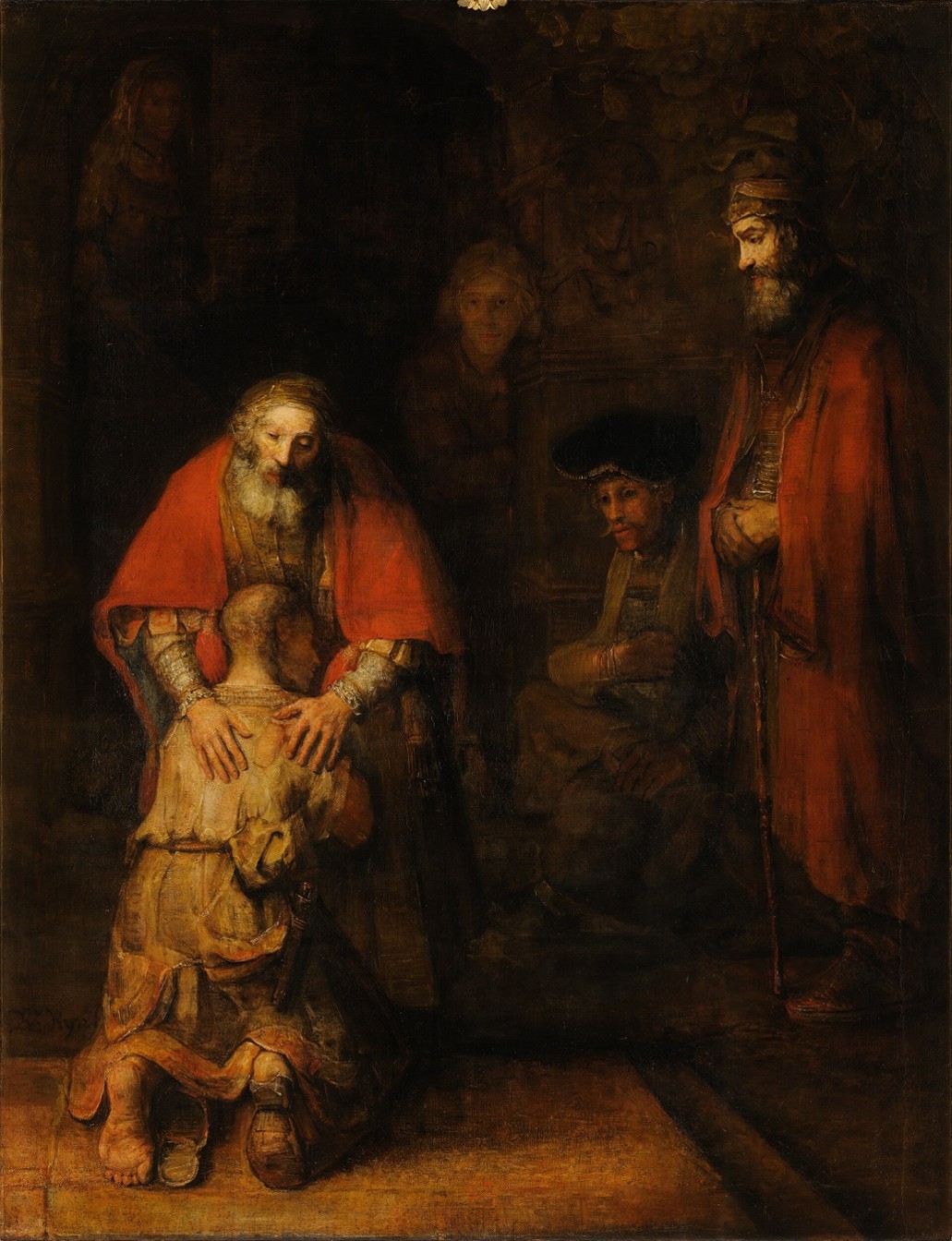
*Rembrandt Van Rijn, The Return of the Prodigal Son, 1663-1665, The Hermitage, St. Petersburg
As we approach Thanksgiving, I want to ask you two questions: What are you most grateful for? And what has been the greatest obstacle to your gratitude?
One painting has caused me to reflect on these questions. It is not a traditional Thanksgiving painting or a scene of abundance and plenty. It is The Return of the Prodigal Son by Rembrandt (1663-1665). The painting reminds me of God’s grace, mercy, and forgiveness through Christ. But it also reveals something surprising: gratitude is often lost not through suffering or lack, but through pride, comparison, and a sense of entitlement.
Let us begin by looking closely at the painting itself. I teach my students that before analyzing artwork, they must practice “slow looking.” They need to notice details and take time to absorb the visual image. At first, there is no judgment or interpretation, only observation. This can be difficult when viewing a familiar story because we naturally want to assign meaning and make assumptions. Here is a brief version of what I see:
This painting depicts six figures, although three are nearly lost in the shadows. They quietly observe the scene unfolding before them. A fourth figure stands prominently to the left, wearing a red cloak and an elaborate turban. These figures direct their attention toward the final two figures embracing.
The embracing figures are illuminated and painted with remarkable detail. An elderly man bends forward to embrace a younger man kneeling before him. The father’s red cloak dominates the composition, drawing our attention to the tender encounter.
The old man’s eyes rest upon the younger man, whose head is nearly shorn. His clothing is ragged, and one worn shoe has slipped from his foot, revealing dirt and sores. His head presses against the old man’s chest, his eyes closed, while his arms cling to the older figure. The pose is almost childlike, even embryonic. We notice that all the figures are dressed in Northern European Baroque clothing.
After this close observation, we consider the meaning and narrative.
The painting illustrates Christ’s parable of the prodigal son in Luke 15. This is a familiar story, becoming part of our cultural vocabulary. The term “prodigal” has become part of our culture, appearing in literature, poetry, film, music, and even advertising. A young man leaves his father, squanders his inheritance, and eventually finds himself penniless, friendless, and feeding pigs. Realizing how far he has fallen, he returns home expecting only to be treated as a servant. Instead, his father runs to meet him, restores him as a son, and celebrates his return. The older brother, however, resents the celebration and believes his years of loyalty have gone unnoticed.
Rembrandt deliberately paints each figure, gesture, and garment to communicate the story. Created near the end of his life, the painting is often interpreted as a meditation on repentance, grace, and reconciliation. The parable endures because we recognize ourselves within it. We all long for forgiveness, hope, unconditional love, and grace.
Naturally, we have no sympathy for the older brother. His judgmental attitude grates against us. He seems unable to understand that his father’s love is not earned through good behavior nor lost through failure.
Yet in some ways there are two prodigal sons in this story. The younger son was lost in rebellion, while the older brother is lost in self-righteousness. The younger son’s failures are obvious. The older brother’s failures are hidden beneath outward obedience.
At the same time, his frustration is understandable. He remained at home and likely witnessed the pain his younger brother caused. Family relationships are complicated, and many of us know what it feels like to watch someone hurt a person we love.
But Scripture reveals a deeper issue. The older brother complains, “Look, these many years I have served you, and I never disobeyed your command, yet you never gave me a young goat, that I might celebrate with my friends.”
His focus is on what he believes he deserves.
The older brother has every reason to be grateful. Everything his father owns will eventually belong to him. Yet abundance does not produce gratitude. Instead, he becomes resentful when undeserved abundance is extended to someone else.
In Rembrandt’s painting, dressed almost like a prince, the older brother stands above his father and brother, looking down upon them. I do not see anger in his face, but neither do I see love or any desire to join the embrace.
We rarely think of ourselves as the older brother. In his book The Return of the Prodigal Son, Henri Nouwen describes how he eventually recognized himself in both brothers and even in the father. He believed Rembrandt likely did the same. That insight is especially challenging for those of us who have spent years in the church. It is easy to drift into superiority, judgment, and entitlement. When that happens, gratitude begins to fade.
This brings me back to my original question: What are you most grateful for?
Earlier I mentioned that the figures wear seventeenth-century Northern European clothing rather than first-century Jewish clothing. This was intentional. By dressing the figures in contemporary clothing, Rembrandt emphasized that Christ’s message transcends time. The parable was as relevant to seventeenth-century viewers as it was to Christ’s original audience.
And it remains just as relevant today.
This painting makes me grateful for the abundant love of the Heavenly Father and the grace offered through forgiveness. It reminds me of the hope, mercy, and salvation made possible through Christ. Even if everything else were taken away, Christians still possess the promise of eternal life. Earthly struggles are temporary, but God’s promises are eternal.
Yet what strikes me most is the older brother’s response. The younger son squandered his inheritance through rebellion. The older brother squandered his through entitlement. Everything in the father’s house already belonged to him, yet he could not rejoice when grace was extended to another.
I know there are times when I fall into that same trap. Pride, judgment, and superiority are the enemies of gratitude. Like the older brother standing apart from the embrace, I can allow entitlement to keep me from thanksgiving.
Rembrandt’s painting reminds me that everything I possess, every blessing I enjoy, and every promise I cherish comes by grace alone. True thankfulness begins when I step into the embrace rather than stand outside it.

Rebekah Cochell
Rebekah is a graduate of Liberty University (MFA: School of Digital and Studio Art: Graphic Design). She is an adjunct professor for Liberty University’s Online School of Communication and the Arts. Currently living in Germany, she is married to James, an Army Chaplain and teaching elder of the PCA. They have three grown children, Ransom, Ethan, and Rose. Rebekah integrates art activities in both the Bible studies she teaches and the chaplain training events that she co-teaches with her husband. She enjoys traveling, photography, painting, and reading the classics. She and her husband live in Huntsville, AL.