
My View from the Back Pew

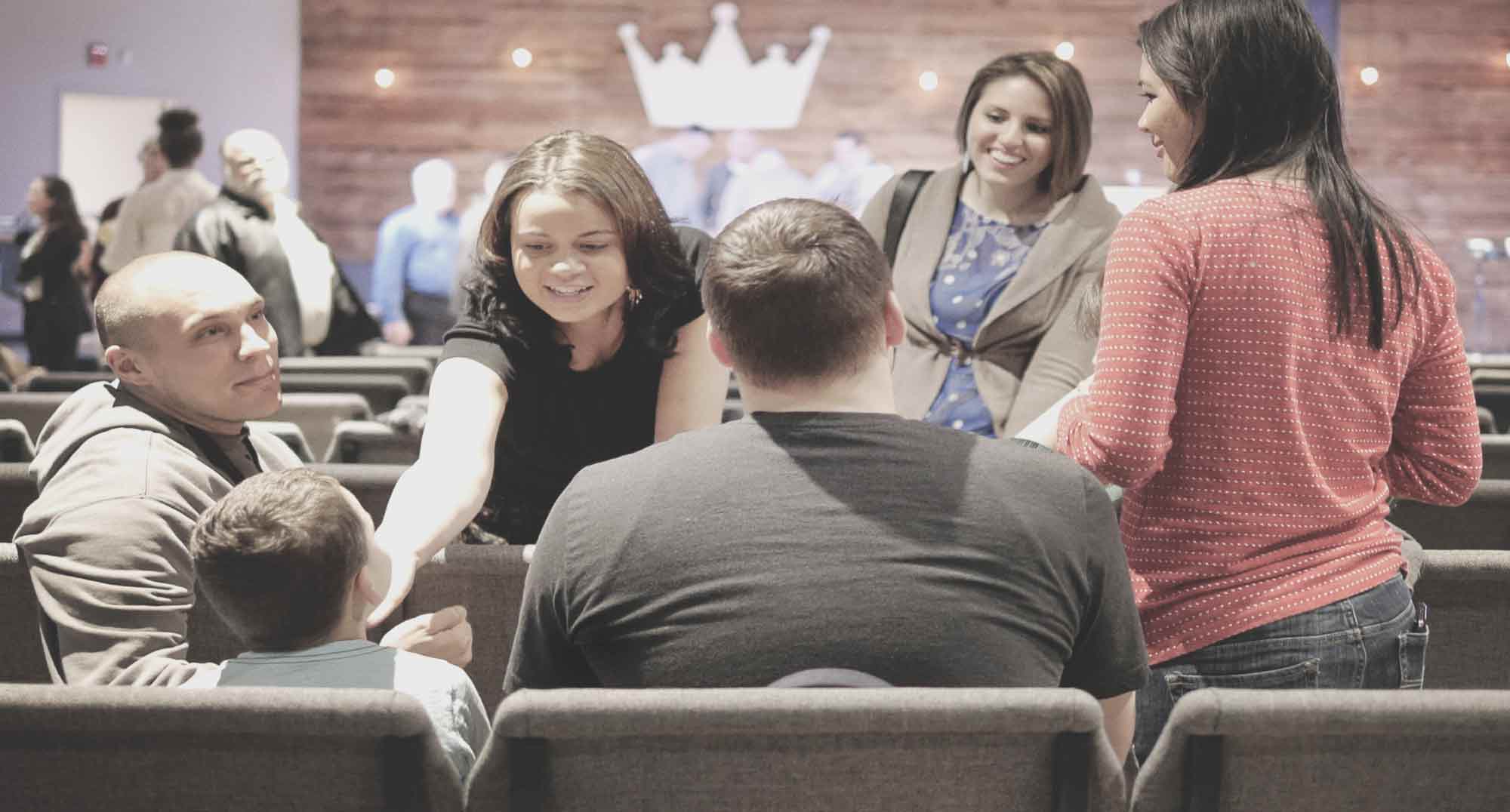
I’m an up-front kind of girl—of the church that is. Every Sunday my husband, boys and I walk right up to about the second row of the sanctuary and make ourselves at home. Immersed in worship I push the distraction of others behind me and enter into communion with our Lord. We sit so close that one time another church member joked “You keep moving up and you’re going to have to preach the sermon!” I’m comfortable in the front, maybe a little too comfortable. Worship from the Back Row Awhile back my husband was asked to serve as a “safety officer” during worship. Every so often, our family would have to move to the back of the church, and I mean the last row so that he could safely observe the congregation in full view. I was not so eager about that part of the commitment. Did you catch the beginning paragraph where I listed all the reasons I love the front row? Did you notice a recurring theme? Me, right? What I wanted, what I felt I needed during worship. Oh, the distractions we would face! My self-absorbed spirit was crushed as I thought of all the visual annoyances I would have to push aside in order to worship. In God’s magnificent providence, he gently turned my sin-filled spirit from one of begrudging a change in scenery, to a beautiful picture of his bride, the church. As I slid in next to my husband in the last row of the sanctuary my eyes wandered to the people around me. So. Many. People. I had an immense sense of trepidation as to what the next hour of worship would hold. If I could find it this easy to wander my eyes, would my heart and spirit follow? Could I even worship with all this spiritual noise before me? Self-absorbed and truly wanting for God’s grace, I made each minute more about myself. I could not have been more devoid of the welcoming and loving presence of my Savior I was supposed to be worshipping. But instead of chastising me, or worse, leaving me to wallow in self-pity, the Lord graciously painted a portrait of how he sees his sheep in the Son-drenched pasture of worship. The Bride Worships I saw a woman struggling with debilitating pain throughout her body break down in tears during the opening call to worship. Another woman from our Bible Study small group noticed and scurried over to put her arm around her, comforting her with a tissue and her own empathetic tears...

My View from the Back Pew2022-05-07T22:28:41+00:00

A Prayer for the Church

What do your daily prayers look like? When I consider my own prayers, I often find myself praying through a list of things I need help with or concerns I have for loved ones and friends. More often than not, my prayers focus on the temporal rather than the eternal, the physical rather than the spiritual. While such prayers are not wrong—for Jesus instructed us to pray for our daily bread—they are missing something. They are near-sighted. Whenever I read Paul’s prayers in the Bible, I see what’s lacking in my own. Paul prays big prayers—prayers which stretch beyond the here and now and into eternity. The prayers he shares in his letters focus on the spiritual health of the church and the growth and spread of the gospel. Prayers such as this one to the church at Colossae: “we have not ceased to pray for you, asking that you may be filled with the knowledge of his will in all spiritual wisdom and understanding, so as to walk in a manner worthy of the Lord, fully pleasing to him: bearing fruit in every good work and increasing in the knowledge of God” (1:9-10). Jonathan Edwards once noted, “…if we look through the whole Bible, and observe all the examples of prayer that we find there recorded, we shall not find so many prayers for any other mercy, as for the deliverance, restoration, and prosperity of the church, and the advancement of God’s glory and kingdom of grace in the world.”[1] If the Bible places such an emphasis on these prayers, should not our prayers be the same? As believers, united in Christ by faith and adopted into his family, we pray to the same Father in heaven. Imagine what might happen if we all came to the throne of grace and asked the Lord to strengthen his church? What if we prayed for the leadership of our churches each day? What if we asked for opportunities to shine a corporate light in our dark communities? What if we prayed for greater unity, a unity that shows the world who Christ is and what he has done (John 17:23)? To that end, here is a prayer for the church...

A Prayer for the Church2022-05-07T22:29:28+00:00

Love One Another Through Hospitality

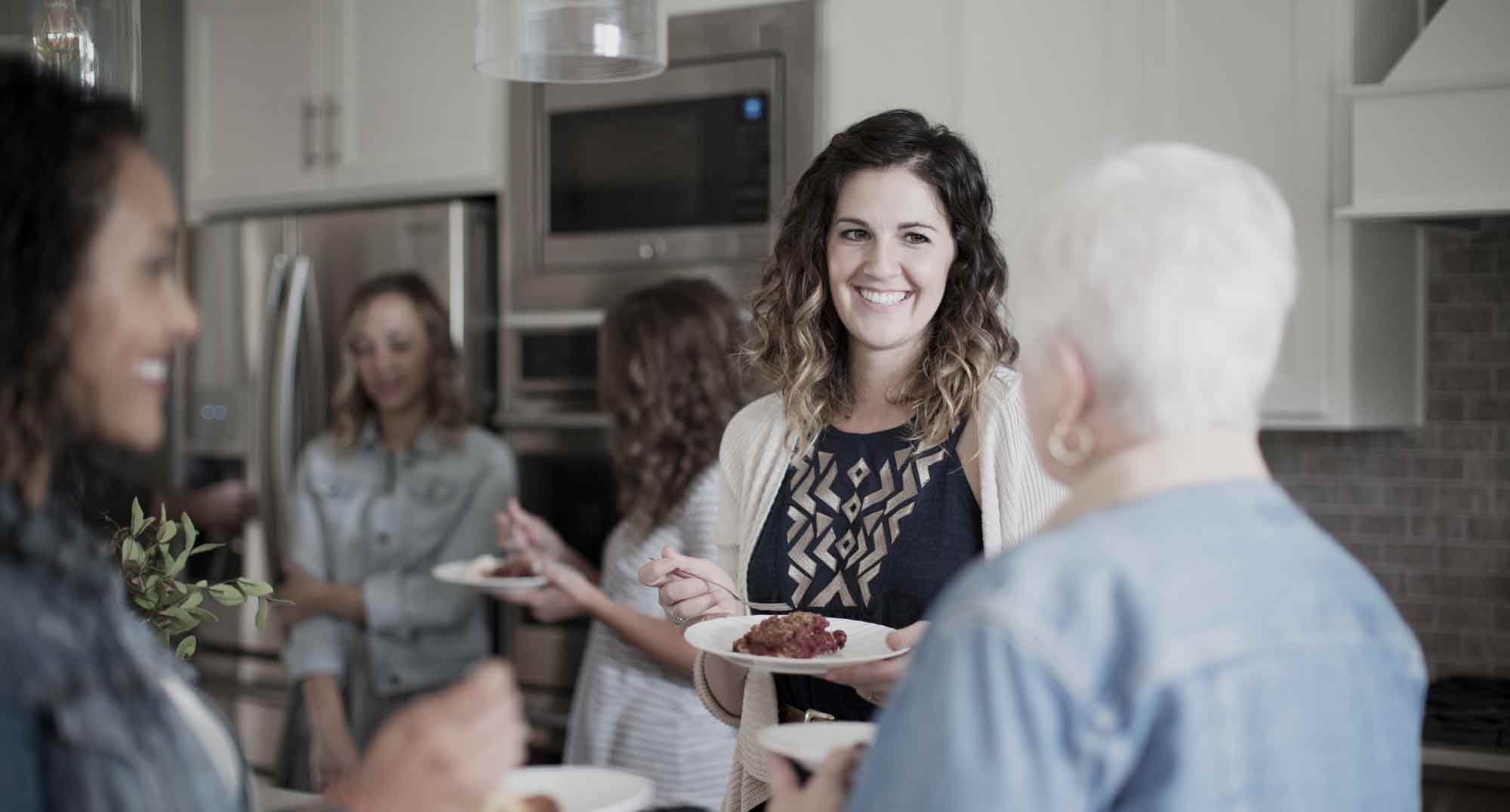
It may surprise those who know me to learn that showing hospitality by welcoming others into my home has not always been a joy. When I was a young bride, my heart did not always join in with the ‘welcoming’ aspect of hospitality as I raced through preparations in a panic. Fellowship may have been at the top of my motives for having company for dinner, but running close behind that goal were insecurity, perfectionism, and the desire to impress. I gave so much effort to planning, cooking, and presenting the perfect menu—with babies and toddlers in tow—that by the time our company arrived I was too wrung-out to enjoy our guests. There are whole evenings and conversations that I cannot remember, other than the stress leading up to them. So why have company at all? Why jump through the hoops if I’m only going to end with a messy kitchen, a mild headache, and no appreciable memory of the evening? Because the Bible tells me to. A Fellowship of Love Well, not exactly. What the Bible tells me has nothing to do with anxiety and the charade driven by insecurity, perfectionism, and the desire to impress others. What the Bible tells me is to welcome others joyfully. Why? Because I have been welcomed into the blessed fellowship of God himself through his Son Jesus Christ...

Love One Another Through Hospitality2022-05-07T22:30:31+00:00

The Good Shepherd’s Pasture

In 2011, our family moved to another state so that my husband, Andrew, could pioneer a new ministry on a college campus. Though unplanned, this change in address also brought a change in our denomination. On one of our first Sunday mornings in our new town, we sat down in the pews of First Presbyterian Church, and I gave my husband’s hand a squeeze. He nodded knowingly in agreement. This was going to be our home. Except one (big) problem for these two Southern Baptists: What to do about infant baptism? I loved the liturgy, agreed with the theology, but I had some problems with the sprinkling of those babies. Did the parents presume these were saving waters? Did they think this was their child’s ticket to salvation to be cashed in at confirmation class? Was it all just a stuffy tradition? Very slowly, I began to intellectually understand why one would choose to baptize their children. I understood the concept of the visible church (church membership) and the invisible church (redeemed hearts). I could make the links between circumcision in the Old Testament with baptism in the New, and I could see how baptism was now a marker showing who belonged to this visible church. I saw no interruptions in Scripture, where families were traditionally dealt with as households. And this made sense to me—that because my children lived in a household of faith, they were set apart in some way. Baptism was a sign to the world and to our children that they were a significant part of the church; they belonged there. But then there was a moment when all of this clicked in my gut, which was a different sort of understanding. A pastor said something to me that changed my whole perspective on my children’s place in the church. He said that one of the best things that we can do for our children is this: Make sure they don’t feel as though we are pushing them outside the gates of the church, and then asking them to find their way back in. They should hear the gospel with clarity, while experiencing the safety of a covenant community. That image of my children being welcomed into the gates of the church settled my heart and gave me a new picture to understand what it meant for them to be in a covenant family...

The Good Shepherd’s Pasture2022-05-07T22:34:38+00:00

The Mixed Messages of Welcoming and Belonging

One warm summer day, many years ago, when our youngest son Tim was a teenager, we were holding our annual “Down Syndrome Extravaganza” at our house. Most people would call it a picnic. However, “extravaganza” always seemed like a better descriptor to our family as the gathering of so many families, with so many children with Down syndrome and all of their siblings simply offered the opportunity for unexpected events to arise. We had some years that we hired neighborhood teenagers to ensure we didn’t lose any “runners” in the chaos. One year, Tim had a good friend with Down’s who was very interested in movies and proceeded to empty all 50-75 DVDs from their respective boxes, scattering them randomly all over the floor while seeking the perfect fit for his viewing interests. On another occasion, we even had a rabid racoon appear on our front porch while friends were arriving with their families and food in tow. As we’ve said many times, “It is never a dull moment here!” My favorite DSE event, however, was the year that Tim was giving tours of his room to guests as they arrived. He’d redecorated his room with Elvis Presley paraphernalia, and was eager to share his collection. Visitors were only allowed in one at a time. He even asked me to serve as his “bouncer.” I had fun standing at the door watching as Tim talked with each visitor. As one of our friends lingered in the room making conversation, Tim finally looked at him and declared, “I’m sorry Mr. Nolt, but your tour is over. Don’t make me call security.” My “bouncer role” quickly reverted to “Mom mode” and Tim and I had a quick little chat about what it means to show hospitality to our guests. Tim was definitely giving folks mixed messages. The truth is, we all give (and receive) mixed messages to (and from) others fairly frequently...

The Mixed Messages of Welcoming and Belonging2022-05-07T22:37:09+00:00

The Beautiful Surrender

I witnessed a beautiful surrender one afternoon while waiting for the bus to come up the road. In the center of our front yard stands a large October Glory maple tree. This tree is the last to change colors every fall, but once the leaves do change color, the tree is the brightest and most beautiful fall tree on our street. As I waited for the bus, I watched the beautiful surrender of one of those tiny orange leaves. The wind came and that little leaf could not hold on any longer. The wind carried the leaf off the branch and gently swirled the leaf to the ground. The leaf did what it was made to do—and the tree would continue to survive even after the surrendering of this leaf. The October Glory will be dormant for a season, but soon it would bear new blossoms and leaves in the spring. Beautiful Surrenders Sometimes on this side of heaven, faithful people face seasons of beautiful surrenders. In the surrendering, God grows His people into maturity. My family faced a season such as this last year. I am a PCA pastor’s wife and a mother to four elementary-aged children. My mother was diagnosed with breast cancer at the age of thirty-three and passed away when she was forty. I was thirty-five at the time and I knew I carried a gene mutation which increased my risk for breast cancer. My doctors and genetic counselors strongly advised me to have a bilateral prophylactic mastectomy. This was an emotionally and physically painful—but beautiful surrender of my physical body. It brought me back to the woundedness of my past and tugged on the heart strings of my story. But in the surrender of my physical self, God was faithful to our family and as we only had Him to cling to—He grew all of us in our faith and trust in Him. A Beautiful Surrender to an Eternal Perspective This life is an entire journey of letting go. Just like the October Glory in my front yard, we are always shedding pieces of the old self as we grow into Christlikeness....

The Beautiful Surrender2022-05-07T22:37:52+00:00

Your Grief is Your Own

RENEE MATHIS|CONTRIBUTOR “Your grief is your own.” These words, spoken by a dear friend this past fall could not have come at a more perfect time. In less than a month’s time, I was hit with a series of losses that knocked me flat. My younger brother took his own life. My dog died. My doctor’s office called with concerning lab results. What is a Christian supposed to do at times like this? Where is the instruction manual? I wasn’t sure what suffering for the glory of God was supposed to look like, but I knew I didn’t have much choice but to walk the path set before me. I’m not an expert in grief. I know there are others who have suffered great losses and are even now facing circumstances that would threaten to undo any of us. At the same time, as one who has traveled through a season of loss, may I share a few things I learned? It is my prayer that the Lord can use my tears for the good of his Kingdom. Suffering Online In today’s hyper-connected online world, we have the capacity to share news quickly. While places like Facebook can be hotbeds of anger and ugly discourse, I encountered something entirely different when my brother Jody died. Every single post—“I’m sorry for your loss” or “Your family is in my prayers”— was a reminder of a friendship, a relationship, a connection with someone who cared what I was going through. If you are ever in a place where you wonder if it makes a difference whether you say anything or not, please hear me. It does. It matters. It comforts. Those words helped to heal my aching heart. Suffering in Public Grief has a way of rearing its unexpected head in the most unlikely of places. I so wanted to worship and be with my local body of Christ, yet I couldn’t hold it together through even one hymn without breaking out the Kleenex. In the early days, the tears would come—and I would let them—at the most inconvenient times and places. This phase didn’t last forever, but I learned to yield to God’s good timing and trust that this was all part of the grieving process...

Your Grief is Your Own2022-05-07T22:38:49+00:00

Union with Christ in the Storms of Singleness

Recently I traveled alone between my two worlds: Philadelphia, my home and vocational base and the Midwest where I have decades-long friendships. Somewhere over Ohio I realized afresh that no one but the Lord really knew me in both worlds. Only Jesus had journeyed with me emotionally, relationally, and spiritually 24/7 in both places. I’ve had many of these heart-pang moments and yet realize that even if I had a traveling companion (friend or husband) who stood by my side, that person wouldn’t know me fully. There is only One who can: Jesus, the one in whom I am hidden in the intimate and unique home that I share with him alone. Our union with Christ is an important truth of the gospel, and therefore our identity as Christians. Whether if single or married, or if you face storms or sweet joys in your life station (most of us experience a combination of both!), the eternal fact of being united to Christ needs to be a primary lens through which we interpret and respond to our circumstances. Including when you’re thirty thousand feet above ground, feeling sad and unknown, and inching towards the downward slide of melancholy. What Union With Jesus Means Jesus helped his friends understand the idea of union with him through a metaphor of a vine and branches. Abide in me, and I in you. As the branch cannot bear fruit by itself, unless it abides in the vine, neither can you, unless you abide in me. I am the vine; you are the branches, apart from me you can do nothing. (John 15:4-5) Paul talked about this spiritual concept in his pastoral letters. I have been crucified with Christ. It is no longer I who live, but Christ who lives in me. And the life I now live in the flesh I live by faith in the Son of God, who loved me and gave himself for me. (Galatians 2:20) For you have died, and your life is hidden with Christ in God.  (Colossians 3:3) “Abiding” (or remaining, having a home) in Jesus, Christ “in us,” and our lives being “hidden” in him all speak to the spiritual reality of our connection to Jesus through faith in his accomplished work on the cross and resurrection. All that was ours (sin and eternal spiritual death) and all that is his (holiness, eternal life, a spiritual nature, identity as the beloved Son) are exchanged. At the cross, he united himself to our hopeless human state and opened the door for us to be grafted into him, gaining access to the riches of heaven!...

Union with Christ in the Storms of Singleness2022-05-07T22:43:15+00:00

Hinged Bible Study: Unpacking the Content of the Gospel in the Context of Community

For the last twelve years, Thursday has been one of my favorite days of the week. Why, you ask? It is Women’s Bible study day. It is a day of blessed belonging. I surround myself with gospel friends who remind me who God is and what He is calling me to be from His Word. On the best days, I leave more vitally hinged to Christ, His Word, and His people. This past year I had to say goodbye to my gospel friends. As we cried and celebrated, we reflected on gospel content that only could have been learned in the context of community. C.S. Lewis said in The Four Loves, “what draws people to be friends is that they see the same truth, and they share it.” The Word of God and our walk together over all these years profoundly shaped me. Hinged Hearsay.... Maybe you had heard the buzz about Hinged. It is the name of our 2020 National Conferences (you heard it here first). It is also the name of the Women’s Bible Study on the book of Ephesians to be released January 2020. (Everyone who registers for the Hinged Conference receives a complimentary copy.) What’s in a name? A hinge is a utilitarian piece of hardware that connects two things for a useful purpose. It is hidden in the gap of a door or cabinet. When a door hinge is operational, we rarely notice, but other hinges in life are far more vital. Being vitally connected to Christ and His Church, well, that is life! Hinged Together.... I often say that I do things the most inefficient, but prayerfully, the most effective way I know how. So instead of having a single author write this study, I invited eight women to collaborate in writing this study together. This group of women from our National Women’s Ministry Team is a unified yet very diverse group of women. They live in different parts of the country. They are of different ages and races. They have unique faith stories. The churches they attend range in size from under 100 to several thousand. It is a love for Christ and His Church that unites them. The book also contains 12 unique stories from women just like you who are seeking to apply the truth of God’s Word right where they live. And when you add up these 20 women you see a picture of the Bride...and she is radiant!...

Hinged Bible Study: Unpacking the Content of the Gospel in the Context of Community2022-05-07T22:48:43+00:00

When Christmas is Not the Most Wonderful Time of the Year

“It's The Most Wonderful Time Of The Year,  It's the Hap-happiest season of all… Except....when it's not. In the days leading up to our first Christmas without our youngest child, sixteen-year-old Mark, Harry Connick Jr.'s merry lyrics sharply contrasted with the tears and unending ache in my chest accompanying me every minute of every day. Even the night of his death, Christmas was on our minds. On our way home from the hospital that hot July night, stunned to be leaving without our child, Chuck grabbed my hand and whispered, "Christmas, what will we do about Christmas?" Over twenty years later, I experience joy in this "most wonderful time of the year" but not because it's the hap-happiest season of all. Because it's not. About two weeks before Thanksgiving I begin to feel disorganized, disconnected, and emotionally edgy. Anger and impatience vie for top billing in situations that don't normally rattle me.  And every year Chuck reminds me that my root problem is grief. I miss Mark. The freight train of sorrow still surprises me with its ferocity and power. One reason the holiday season is so difficult for grieving Americans is because marketing gurus tap deep into our core need for community and family. Thanksgiving and Christmas are ready made opportunities for stirring up our God-given hunger for peace and whole families. The most effective ads are those that imply their product will produce healthy, conflict-free relationships. Divorce, broken relationships, childlessness, loss of a loved one, financial disaster, singleness, conflict-filled marriage—none of these fit the "hap-happiest time of the year" template. The ads only serve to magnify the holes in our own broken lives. 10 Tips for Christmas Grief Relief...

When Christmas is Not the Most Wonderful Time of the Year2022-05-07T22:50:24+00:00
Go to Top