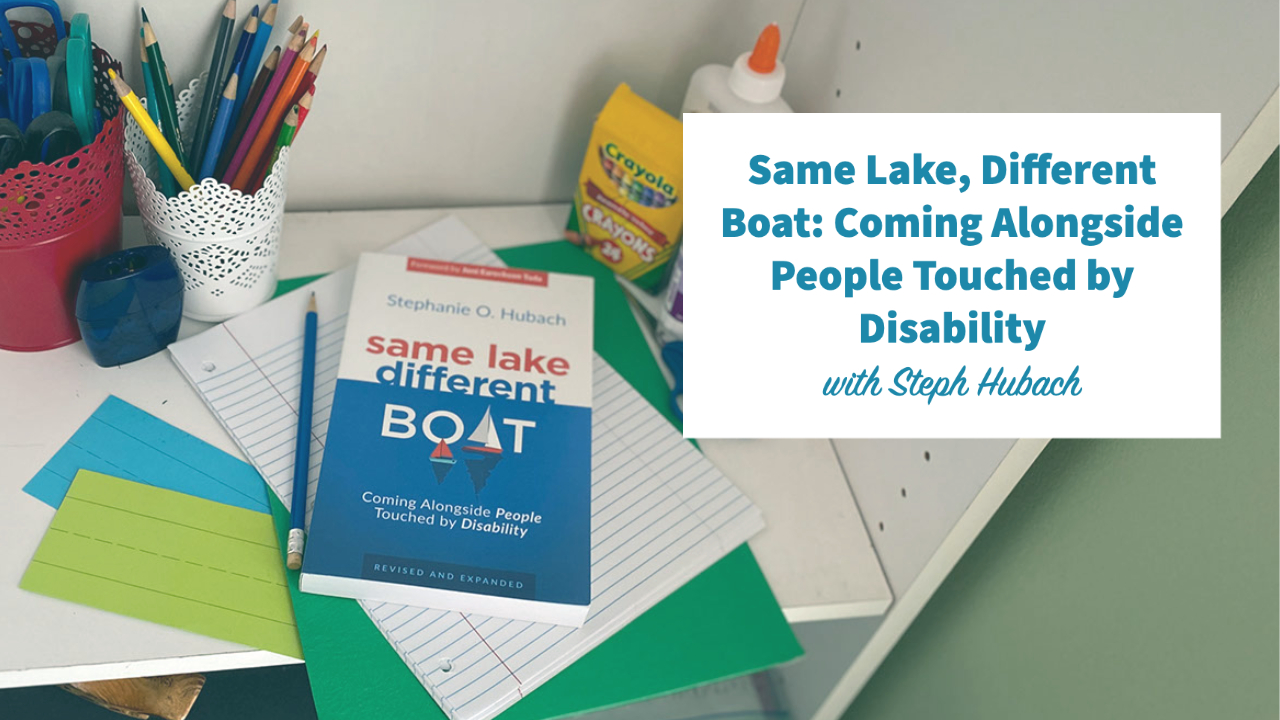
E-111 Same Lake, Different Boat: Coming Alongside People Touched by Disability with Steph Hubach
Have you ever longed to come alongside a [...]

Have you ever longed to come alongside a [...]

Almost ten years ago, when I moved to South Africa, I had no idea how much of an impact this place would have on me. One of the greatest impacts on me is the value the African culture places on the family, as well as community. You see this in the way they sacrifice for one another. You see this in their sense of togetherness. And you see it in the way they come together and celebrate one another for special occasions, especially weddings. It is a community wide event, not just in attending the ceremony, but also in putting the event together. On that special day, hundreds of people come to celebrate the bride and groom. That’s because their community is like a family. And in a similar way, so is the church. The Body of Christ In 1 Corinthians 12:12-30, Paul compares the church to the human body. He begins with “For just as the body is one and has many members, and all the members of the body, though many are one body, so it is with Christ.” Paul illustrates that while a body has a head, eyes, ears, etc. all those parts belong to the same body. So it is with the global church; there are many members scattered throughout the globe, but our oneness in Christ makes us family....

COVID-19 placed a drain on medical personnel we nurses didn’t see coming. We’ve managed infectious diseases before, handled cumbersome PPE, and even ventured into uncharted waters with a diagnosis we weren’t sure how to handle. But I must admit, the Monday morning when the COVID numbers at my hospital unit jumped into the double digits, and doubled again by the end of the week, pandemic seemed an appropriate word. I placed a call to my pregnant daughter, Anna, and told her that until I was no longer caring for these patients, it would be safest if I did not see them. My two-year-old granddaughter didn’t understand why she couldn’t go to Grandma’s. On my way into work one morning a woman stopped me. “Can you get a message to my husband? I can’t go in, can I?” The eighty-something woman gripped her walker and seemed frantic. I recorded her message on my cell phone and left her on a nearby bench. Outside her husband’s hospital room, I grabbed a gown, shoe coverings, hair net, mask and face shield, and gloves. I put my cell phone in a clear plastic bag and prayed it wouldn’t obscure the picture too much. Her husband listened to the message as tears streamed down his face. He mouthed a thank-you through his nonrebreather. I couldn’t do all the usual satisfying nurse things like hold his hand or give him a hug. Neither could I offer that to his wife. It felt so pathetic, holding up a cell phone in a plastic bag, hoping he could see her, hear her. Afterwards, I tramped back downstairs brushing past a coworker who asked if I was ok. I nodded a yes, but I meant no. Outside, that sweet wife was waiting. At least I could tell her he heard her voice and seemed to know it was her. I swallowed hard, wrote my cell number down on a piece of paper and handed it to her. “Anytime you need to get a message to your husband, you call me. Anytime, ma’am. I will meet you here.”

We live by catchphrases such as , the past is the past; it happened so long ago; forget and move on. They are go-to sayings intended to shift us from a state of wallowing, ruminating, and circling the same mental track. We favor and praise them because they aid us in leaving behind regrettable, undesired experiences. So when I read the Apostle Paul’s prescription to remember in Ephesians 2:11-12 as I participated in the Hinged Bible Study on the book of Ephesians, I found myself struggling to register its importance. Why are we to remember the former life when later, Paul instructs us to put off the old self?[1] Furthermore, is remembering up to the individual or is remembering to be done in the context of community? Let us first consider the why. Why We Remember Chapter 2 begins by reviewing our history— you were, you once walked, we all once lived— before pivoting in verse 4 with an emphatic, “But God” statement and pointing our attention to the source, reason, and purpose of our redemption. The walk down memory lane is not to elicit guilt or shame but to glory in the difference the gospel makes. God’s “rich mercy” and “great love” “made us alive together with Christ” and “raised us up with him and seated us with him in the heavenly places in Christ Jesus.”[2] The purpose for remembering is also so that we would stand firm in the finished work of the blood of Christ; his blood brought us who were once far off near (verse 13) and inducted us from strangers and aliens to citizens (verse 19). Furthermore, our stories of how we came to be are to be remembered— and remembered viscerally. In the 2006 film Amazing Grace, the British abolitionist William Wilberforce, seizes an opportune moment to capture the imagination and conscious of elite Londoners. They are gathered aboard a cruise ship and pass Madagascar, a slave ship. As they near it, they are repulsed by a putrid foul smell that Wilberforce names as “the smell of death.” When they try to filter the stench with their handkerchief and hands, Wilberforce confronts them. He says, “Breath in it. Breath it deeply. ... Remember that smell. Remember the Madagascar. Remember that God made men equal.” Remembering is not limited to fond, feel good, celebratory moments but also to those that cause disbelief, grief, and even horror so that we have no appetite for the desires that lead us astray from God and to death...
Do you believe that "we" is better than [...]

What are the fears that are holding you [...]

Are you more inclined to be merely informed [...]
Long for your prayer life to be revitalized? [...]

What truths can you be certain of in [...]

When it comes to He Who Must Not Be Named, most of us know full well what not to do by now—but what can we do to encourage one another as we go about our quiet days at home? It’s not a difficult reach to guess how disconnected and unmotivated we might feel without regular interaction, and especially without communal worship and fellowship. And it doesn’t take a PhD in Social Psychology to know many of us may be diagnosed with a raging case of the empties (if not the actual Coronavirus) before the Covid-wave passes. Knowing I’m about to have a lot of time on my hands, I’m looking for ideas for those quiet midday Tuesdays when it’s going to be tempting to find myself hollowing out to a sneaky and unintended Netflix binge or playing the day’s 10th round of that addictive phone game. I’d love to make some choices that edify Christ, myself as a Christ-follower, my family whom I want to love well, and my friends and neighbors—believers and non-believers alike—both over the fence and over the WiFi. With that in mind, here are a few ways for you/me/us to consider the lonely, and expand the definition of who that could be and what that could look like. Say hello to your neighbors. Knock on a front door and tell them you just wanted to see their face and ask if they needed anything...