
REBEKAH COCHELL | GUEST
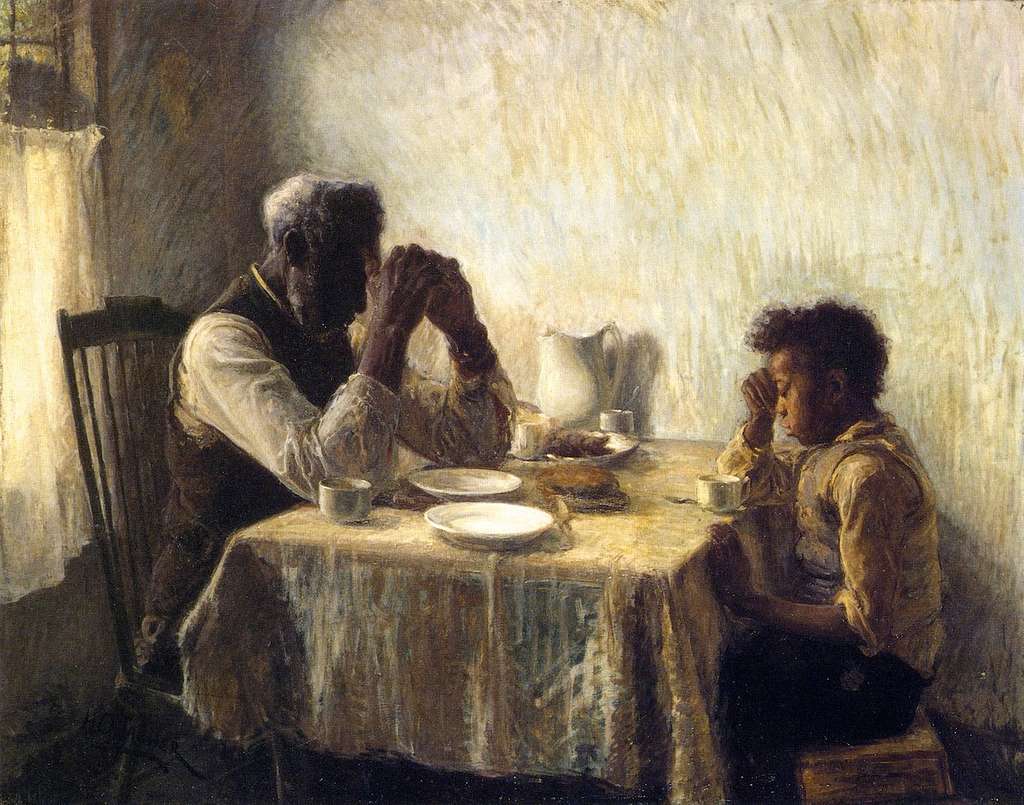
Henry Ossawa Tanner, The Thankful Poor,1894, Art Bridges Foundation currently exhibited at the Memphis Brooks Museum of Art.
“Do not be anxious about anything, but in everything by prayer and supplication with thanksgiving let your requests be made known to God. And the peace of God, which surpasses all understanding, will guard your hearts and your minds in Christ Jesus.” Philippians 4:6-7
Art can reveal truth, beauty, and goodness by depicting the spiritual transcendence of everyday life. “The Thankful Poor” by Henry Ossawa Tanner reveals a humbling lesson in thankfulness instead of merely offering us a depiction of the harsh realities of the late 1800s.
Thanksgiving Reflected in Art
Henry Ossawa Tanner was an artist born in Philadelphia in 1859. His experiences as a Black artist, during the Reconstruction and the Industrial Revolution in America, and in France shaped him as a Christian and an artist. He was a follower of Christ and painted many biblical narratives. He didn’t limit his Christian lens to just biblical paintings. His everyday “genre” scenes were imbued with deep emotional and spiritual depth, as well.
As we look at this painting, we see an elderly man with graying hair and a young boy sitting at a table. The table is set simply, white dishes, cups, and pitcher with a modest meal, on top of a creamy yellow cloth tablecloth. The walls are bare and plain white. But the light from the window filtered through white curtains fills the room and all in it with an ethereal glow. The elderly man’s hands are clasped, eyes closed, and head bowed in a posture of reverent prayer. The young boy’s eyes are closed and head bowed, resting on one hand. His posture is a little less formal, as his left hand rests on the edge of the table. Their clothing, simple yet sophisticated, depicting care.
The scene is reminiscent of a Vermeer; quiet, still, a moment in time that is transcendent. The window light illuminates the interior space. The simple white jug, an essential everyday item, represents life giving properties. Like Vermeer, Tanner depicts those who labor, rather than those in positions of power. He is telling a story. But the story is not defined; we don’t know who the man and boy are other than what we can observe in the image and know from history.
The title of the painting lets us know they are poor. The room, the table, and the meal confirm this. We know from history that the Reconstruction and the following Gilded Age, when this was painted, did not result in wealth for the Black community. It did not end racial discrimination. Tanner himself, though extremely talented, faced discrimination. His paintings would be shown in “separate” exhibits since he was not White. He left America to pursue his art career in Paris, where he was recognized and his talent celebrated.
While we can and should lament the past, Tanner rose above it, and above those who mistreated him. He did not wallow in the injustice but used it to paint truth as in this painting where he depicts the dignity and worth of the old man and young boy, created in the Imago Dei.
But he reveals more, a man who is teaching a boy about giving thanks to God for supplying their needs, humble though the meal looks to us. We know the man had suffered, faced economic hardship, discrimination, and injustice. Yet the man bows his head and gives thanks to his Creator. He doesn’t keep this to himself; he is teaching the boy gratitude, thankfulness, and a love for God. This moment is one of teaching, training, and loving. It is a moment of a man passing his faith to a child through his actions and attitude. I see this as a visual depiction of Philippians 4.
Pray and Give Thanks
Philippians 4:8 has always been one of my favorites and has helped me focus on the true, the good, the lovely. The world today is filled with so much pain and agony. When you think about it, the world contains all the opposites of Philippians 4:8: it is filled with lies, dishonor, injustice, impurity, ugliness, and shame. Turn on the news and in a matter of few minutes, this is evidenced throughout the world. It is quite depressing.
It’s not just “out there”; it’s within our churches, families, and communities. Our families suffer from heartbreak and pain and illness, and our communities face destruction from natural and man-made causes. Many of us have personally grieved and experienced trials. Yet, these verses tell us not to be anxious, but to pray and THANK God for everything, while asking Him for deliverance.
But how is that possible? The two preceding verses, Philippians 4:6-7 expands the focus of verse 8 commanding us not to be anxious, but in “prayer and supplication to make your requests known to God” and then presents the hope of having a peace that surpasses understanding in Christ Jesus. Supplication is the key here, I think. It means the action of asking or begging for something earnestly or humbly. So, the act of praying, with Thanksgiving, should include this humble begging of God. And that is what I see in this painting. We don’t know the specifics, or his requests, or his words. But the essence of this prayer is there.
This painting urges me through this Thanksgiving season to not only be thankful, but to demonstrate the command of Philippians 4 to not be anxious, to pray and to humbly ask of God to ease the aches of my heart. And through the demonstration, to pass this legacy of hope and thanksgiving to my children.
*Photo: https://picryl.com/media/the-thankful-poor-1894-henry-ossawa-tanner-6357d3

Rebekah Cochell
Rebekah is a graduate of Liberty University (MFA: School of Digital and Studio Art: Graphic Design). She is an adjunct professor for Liberty University’s Online School of Communication and the Arts. Currently living in Germany, she is married to James, an Army Chaplain and teaching elder of the PCA. They have three grown children, Ransom, Ethan, and Rose. Rebekah integrates art activities in both the Bible studies she teaches and the chaplain training events that she co-teaches with her husband. She enjoys traveling, photography, painting, and reading the classics.