
REBEKAH COCHELL | GUEST
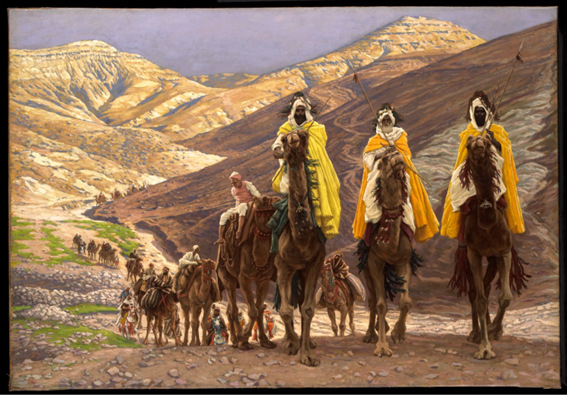
James Tissot, Journey of the Magi, 1894, Minneapolis Institute of Art. Public Domain.
There is a Christmas poem that has haunted me ever since I read it years ago: The Journey of the Magi by T. S. Eliot. It is not your typical cheerful Christmas poem; it has a somber tone, contrasting the Birth of Christ with death. Yet I keep revisiting it, finding truth and beauty—and, ironically, Christmas cheer. If you are unfamiliar with it, you can read it here.
A Brief History
Between 1927 and 1931, the publisher Faber & Gwyer created Christmas pamphlets called the Ariel Poems. Each pamphlet was a collection of beautifully illustrated Christmas poems meant to be given as Christmas cards. They were collaborations between popular poets, artists, and typographers. Among them, Eliot’s Journey of the Magi (1927) stands out as a strange inclusion.
It begins:
‘A cold coming we had of it,
Just the worst time of the year
For a journey, and such a long journey:
The ways deep and the weather sharp,
The very dead of winter.’
Eliot’s poem narrates the journey found in Matthew 2 from one of the Magi’s perspectives. While Eliot takes creative liberties, the poem speaks truth to our own spiritual journey when we follow Christ.
After describing the hardship of the journey, the Magus writes:
“This: were we led all that way for
Birth or Death? There was a Birth, certainly,
We had evidence and no doubt. I had seen birth and death,
But had thought they were different; this Birth was
Hard and bitter agony for us, like Death, our death.” (Eliot)
Birth
Birth… hard and bitter agony. We usually think of Jesus’ birth as joyful, not agonizing. Yet every birth carries pain and transformation. Every mother faces the death of her former life as her focus and energy revolve around her newborn child. A mother becomes a continual life-giver, initiated by birth—and by a death to selfishness. She can never go back to her former careless life. The birth of Christ was no different. Beyond physical pain, there was a death to the life Mary knew before.
Evangelicals often gloss over Mary’s role for fear of idolatry. But we should not forget that Mary is singular, she is the only mother whose womb held God. The infinite God who created the universe dwelt in her womb. She paid a cost: leaving her parents’ home, marrying a man who believed her story of the immaculate conception only after his own angelic vision, and traveling on a donkey late in pregnancy under harsh conditions.
Then came the birth itself: arriving in Bethlehem, finding no room to lodge in, and giving birth in a stable (whether cave or barn; it was a place where animals were kept). God clothed in human flesh entered the world in the humblest of conditions. This birth was infinitely beyond all others. Young and inexperienced, Mary bore the responsibility of caring for the Son of God.
Such a strange story when you really ponder it.
Death
Christ’s birth was always meant to lead to His death—and ours. The death to old lives and old selves. The journey can be hard, before and after—the transformation of hearts of stone into flesh, a life seen as foolish by the world. Just as the Magi are called fools in the poem, so the world calls all who are in Christ.
“We returned to our places, these Kingdoms,
But no longer at ease here, in the old dispensation,
With an alien people clutching their gods.” (Eliot)
The Magus saw the death of his old self. Is he mourning what he once was? I do not think so. These wise men—wealthy, respected, knowledgeable—were changed forever by their journey. Their eyes opened to the vanity of their former life. The sadness comes from knowing their people were lost, “alien people clutching their gods.”
After Christ transforms us, we no longer feel at home in the same places. We mourn for those we love who are lost. We feel displaced. The home we once knew feels foreign.
“I should be glad of another death.” (Eliot)
Though somber and almost fatalistic, the final line encapsulates the journey: glad of another death. What death is this? C. S. Lewis described Joy as that stab of longing for heaven—for God’s presence—an ache more beautiful than any earthly pleasure.
Sorrow for our world and a painful longing for heaven and eternity with Christ.
A Question for Us
Would you do it again? I do not know a mother who regrets the birth of a child—but what of our spiritual birth? The painful journey? The death of our old selves? The grief for those still lost?
This Christmas, as we celebrate Christ’s birth, let us remember all that His birth means. Reflect on how the Eternal God entered time through a young girl’s womb. Rejoice that He still enters our lives, renewing hearts and reshaping souls so that we may shine His truth and love to those around us.
Works Cited:
Eliot, T. S. “Journey of the Magi.” Poets.org, Academy of American Poets, https://poets.org/poem/journey-magi. Accessed 20 Nov. 2025.
Lewis, C. S. Surprised by Joy: The Shape of My Early Life. Harcourt, Brace & World, 1955.

Rebekah Cochell
Rebekah is a graduate of Liberty University (MFA: School of Digital and Studio Art: Graphic Design). She is an adjunct professor for Liberty University’s Online School of Communication and the Arts. Currently living in Germany, she is married to James, an Army Chaplain and teaching elder of the PCA. They have three grown children, Ransom, Ethan, and Rose. Rebekah integrates art activities in both the Bible studies she teaches and the chaplain training events that she co-teaches with her husband. She enjoys traveling, photography, painting, and reading the classics.