
Big Picture Parenting

SHEA PATRICK|GUEST Lately, it seems I am often at wit’s end in my parenting. We have five children in the home between the ages of 8 and 13, and many days it is a struggle to keep my head above water. In the midst of this chaos, I have found that an understanding of covenant theology—the big picture of God’s steadfast love and faithfulness to His children— provides real gospel hope for parents just like me. These three specific truths have anchored my mind and heart: God has not left me alone; he is with me. I often feel crushed by the weight of the responsibility of parenting these children God has placed in my family. I desperately want to make the best decisions for them. Fortunately, I can rest in the fact that these children are the Lord’s; he loves them and is more committed to them than even my husband and I are! Even more, the promises God made to Abraham apply to my family because we are part of the covenant family. In Genesis 17:7, God promises “And I will establish my covenant between me and you and your offspring after you throughout their generations for an everlasting covenant, to be God to you and to your offspring after you.” Through my union with Christ, this promise is extended to me as well. As Paul wrote in Galatians, “if you are Christ's, then you are Abraham's offspring, heirs according to promise” (3:29). What this means practically is that God walks with me as I parent my kids— as I try to address the needs that arise moment by moment. He does so as my Father, parenting my own heart as I then seek to parent my children. My elder brother, Jesus, is an ever-present friend and intercedes for me in my weakness and failures. The Spirit is at work in me, transforming and changing my heart even as he works in my own children’s hearts...

Big Picture Parenting2022-05-04T23:06:25+00:00

Church is Hard, So Keep Showing Up

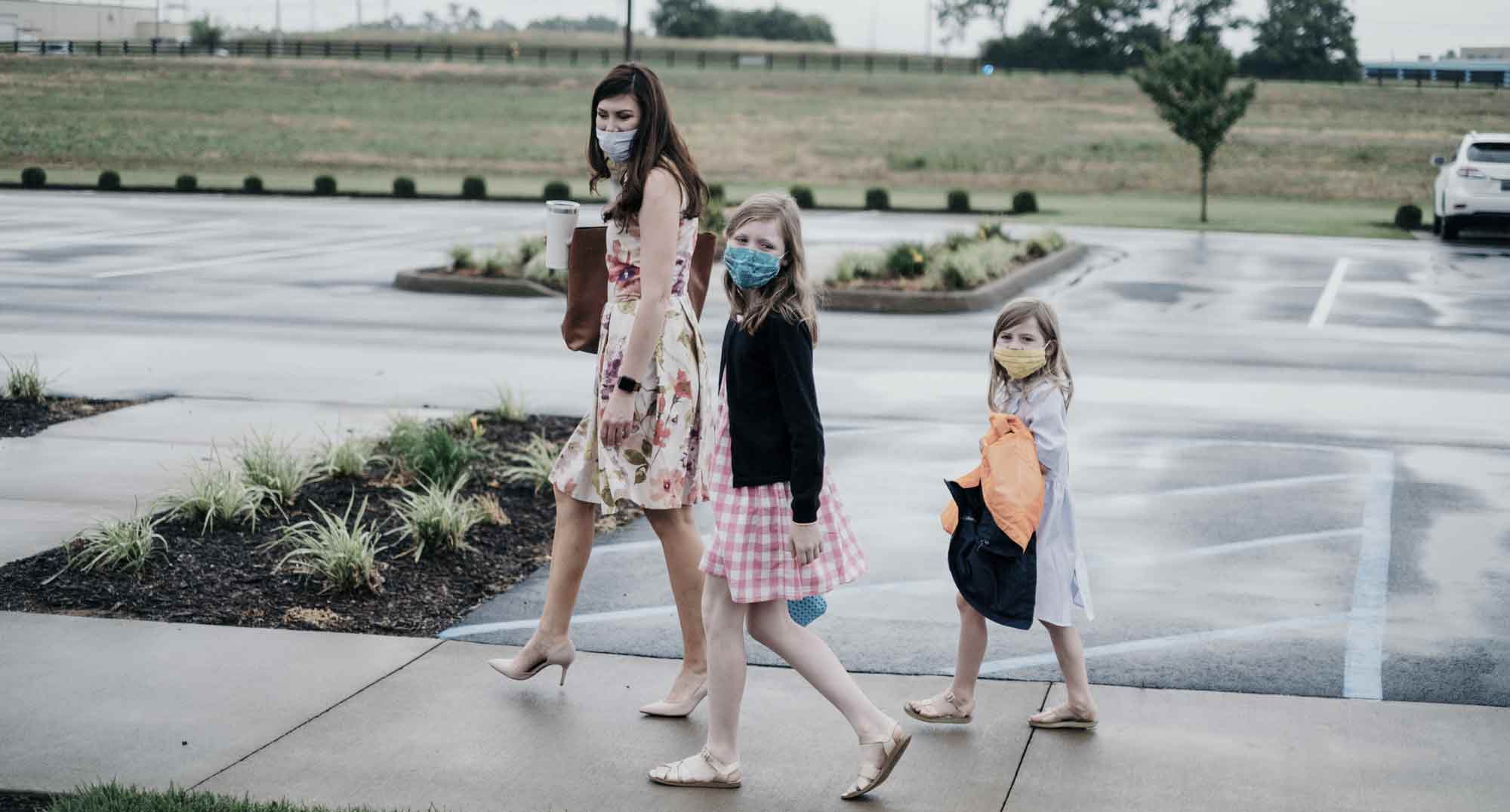
Anybody who knows me would call me a social butterfly. They might even joke that I go to church mainly for the coffee and fellowship. Well, they wouldn’t be far off. I so enjoy studying God’s word, singing rich worship songs, and hearing a gospel-centered sermon on Sunday morning. But I also enjoy gathering and talking with other believers, encouraging one another in the Lord. Isn’t that what draws most of us to a church—the people who welcome us and walk alongside us on the journey of faith? Anything but Normal Then came a pandemic, and as you know, things have changed drastically for churches and congregations across the country. COVID-19 hit, and we were left trying to figure out how to make Sundays normal when they are anything but normal. When the pandemic first arrived, my church met virtually. It was novel and cool for the first couple of weeks, but before long the newness of the experience wore off. For the last few months, we have been worshipping together through a limited outdoor and indoor service. Most people wear masks and leave quickly. Between the wind, the heat, and tired kids, it is hard to stay present during the service. My mind wants to wander to my to-do list or to the problems in my life that I think I can solve (instead of listening to the sermon and hearing from the God who holds all things together). I struggled with these things before COVID, but they feel especially prevalent now. Fellowship is the most difficult, because in order to hold services we must remain physically distant. Most people go home right away after the service. Conversation is hard. It is hard to know what to talk about except the “thing” that made fellowshipping hard in the first place. And no one actually wants to talk about the “thing” that is on our minds all the time. I am weary, and some Sundays I really don’t want to go. I would rather push against the hard than embrace it. Encouragement When Church Feels Hard The early church definitely knew something about hard. Between family divisions (Mark 10:29), disputes among church members (1 Cor. 6:5-6), and various forms of persecution and suffering(Acts 8:3, Heb.13:3), the believers of the early church definitely had reason to stop going. But this is exactly why Paul felt called and inspired by the Spirit to write and encourage the early churches in his letters....

Church is Hard, So Keep Showing Up2022-05-04T23:56:18+00:00

Covenant Friendship

On this day he looked more like a man than a boy. The gore of war had spattered and stained his person. Adrenaline laced fingers intwined themselves in the trophy’s scalp – a bodiless head swinging slack-jawed before the king’s throne.[1] David presented the head of the giant to King Saul. The king grunted his approval. The palace court humbled itself into silence. No warrior had been found to stand for Israel against the blasphemous enemy – none but a young shepherd with his sling shot and an unwavering faith in Yahweh. From the corner of the room, King Saul’s son, Jonathan, watched and listened. “Whose son are you, young man?” the king inquired. Bowing his head, David replied, “I am the son of your servant Jesse the Bethlehemite.” At that moment Jonathan’s heart swelled with affection. A love that only the power of Yahweh could provide burned within the young prince. Jonathan saw beyond the simple clothing and the country accent. He saw a brother in the Lord and a friendship that would endure for a lifetime. If David could slay a seasoned warrior with a smooth river rock, what could he do with the proper equipment? Pulling the young shepherd aside, Jonathan began to disrobe the finery he was born into. The opportunity to outfit a new hero would not be lost to the prince. Jonathan saw potential. He would play his part in shooting this champion to stardom! Over David’s rough, wool tunic a royal robe was draped, and a fine belt was strapped. David’s heroic heart was protected by princely armor. A well-balanced sword and a finely strung bow completed the arsenal in the shepherd’s hands. Jonathan gave David a royal outfitting. He gave his beloved friend power, protection, and a new identity. David was a more than a man when he hit the return road home. He was a celebrity. From every city, clogging every road, women surged forward with instruments and voice. Colorful skirts twirled in delight. Eyes sparkled with victory. Bracelets jingled on dainty wrists to the beat of the tambourines. The contagious smiles reenergized David on this day that was for him. This day the women celebrated and sang:               Saul has struck down his thousands,               and David his ten thousands.  The Blessing of Godly Friendships God unites people together for all sorts of reasons. He places encouragers to lift us up when we’ve hit a low point. He rallies champions when we’ve lost the power to fight another minute. He brings admonishers and counselors to guide us through sticky decisions. He gifts us lovers and friends to sweeten our days with laughter and joy. Godly friends are easily identified by their actions...

Covenant Friendship2022-05-05T00:02:08+00:00

The Global Church as Family

Almost ten years ago, when I moved to South Africa, I had no idea how much of an impact this place would have on me. One of the greatest impacts on me is the value the African culture places on the family, as well as community. You see this in the way they sacrifice for one another. You see this in their sense of togetherness. And you see it in the way they come together and celebrate one another for special occasions, especially weddings. It is a community wide event, not just in attending the ceremony, but also in putting the event together. On that special day, hundreds of people come to celebrate the bride and groom. That’s because their community is like a family. And in a similar way, so is the church. The Body of Christ In 1 Corinthians 12:12-30, Paul compares the church to the human body. He begins with “For just as the body is one and has many members, and all the members of the body, though many are one body, so it is with Christ.” Paul illustrates that while a body has a head, eyes, ears, etc. all those parts belong to the same body. So it is with the global church; there are many members scattered throughout the globe, but our oneness in Christ makes us family....

The Global Church as Family2022-05-05T00:03:05+00:00

Five Ways Women’s Ministries Can Care for Victims of Domestic Violence

Most likely, around 25% of the women attending your church are victims of domestic abuse.[1] When you see that number, is your first thought disbelief? Mine certainly was, and I am what some would call an expert in this area. But in ministering to the women in my church, I have sadly witnessed its truth firsthand. We struggle to believe that domestic abuse is in our churches for three main reasons. First, abuse is a hidden reality. It happens behind closed doors. The sinful tactics used by an abusive husband are inconceivable, in part because abusers strive to keep their deeds hidden in darkness (John 3:20). Second, abused women often do not identify as victims; they feel responsible for their oppression. Most women come to me for counseling about something else, such as anxiety, depression, or guilt. Oppressors confuse their victims to control them; a common by-product of sin is “disorder” (James 3:16). Victims often do not possess the clarity required to conceptualize what they are enduring is abuse. Third, we struggle to identify abuse because the oppressor usually attends our church. We have talked and prayed with him. We think we know him. In reality, we only see how he presents his public face. At home, oppressors are very different people. Even though Scripture warns us about deceivers (2 Timothy 3:13), we struggle to identify them among the people we think we know. Although we often are not aware of abuse, the Lord sees victims and is active in their rescue (Luke 4:18–19). I also believe that God calls us to join him in their rescue. Below are five ways the women’s ministry in your church could help identify and care for the sufferers in your midst...

Five Ways Women’s Ministries Can Care for Victims of Domestic Violence2022-05-05T00:03:55+00:00

Remembering in Community

We live by catchphrases such as , the past is the past; it happened so long ago; forget and move on. They are go-to sayings intended to shift us from a state of wallowing, ruminating, and circling the same mental track. We favor and praise them because they aid us in leaving behind regrettable, undesired experiences. So when I read the Apostle Paul’s prescription to remember in Ephesians 2:11-12 as I participated in the  Hinged Bible Study on the book of Ephesians, I found myself struggling to register its importance. Why are we to remember the former life when later, Paul instructs us to put off the old self?[1] Furthermore, is remembering up to the individual or is remembering to be done in the context of community? Let us first consider the why. Why We Remember Chapter 2 begins by reviewing our history— you were, you once walked, we all once lived— before pivoting in verse 4 with an emphatic, “But God” statement and  pointing our attention to the source, reason, and purpose of our redemption. The walk down memory lane is not to elicit guilt or shame but to glory in the difference the gospel makes. God’s “rich mercy” and “great love” “made us alive together with Christ” and “raised us up with him and seated us with him in the heavenly places in Christ Jesus.”[2] The purpose for remembering is also so that we would stand firm in the finished work of the blood of Christ; his blood brought us who were once far off near (verse 13) and inducted us from strangers and aliens to citizens (verse 19). Furthermore, our stories of how we came to be are to be remembered— and remembered viscerally. In the 2006 film Amazing Grace, the British abolitionist William Wilberforce, seizes an opportune moment to capture the imagination and conscious of elite Londoners. They are gathered aboard a cruise ship and pass Madagascar, a slave ship. As they near it, they are repulsed by a putrid foul smell that Wilberforce names as “the smell of death.” When they try to filter the stench with their handkerchief and hands, Wilberforce confronts them. He says, “Breath in it. Breath it deeply. ... Remember that smell. Remember the Madagascar. Remember that God made men equal.” Remembering is not limited to fond, feel good, celebratory moments but also to those that cause disbelief, grief, and even horror so that we have no appetite for the desires that lead us astray from God and to death...

Remembering in Community2022-05-05T00:08:03+00:00

Five Lessons in Waiting on the Lord

I was 23 years old when I started praying daily for my husband and 33 when I met him. From the time we came home from our honeymoon, we prayed the Lord would make us parents. It wasn’t until the day before our 3rd anniversary when we finally received a positive pregnancy test. Waiting has often been a painful part of my story, but as I look back, I can see the Lord’s hand through it all. In many ways, the waiting was and is not complete, but in that sense I feel a kinship with many familiar Bible characters, and more so, the ultimate story of redemption. We are all waiting, aren’t we? How I long to wait well and in ways that honor God! When it comes to waiting well, the following are five helpful principles I’ve learned during long seasons of waiting: Be Honest with God. Your Heavenly Father knows you are in a season of waiting. He hears every cry of your heart, sees every painful tear that falls, feels every flicker of hope you feel. He knows it all, yet He longs for His children to be honest with Him, to wrestle with Him, and to continue to respond to Him in prayer, petitioning and trusting that He has not forgotten you. As Elisabeth Elliot said, “Waiting on God requires the ability to bear uncertainty, to carry within oneself the unanswered question, lifting the heart to God about it whenever it intrudes upon one's thoughts.”..

Five Lessons in Waiting on the Lord2022-05-05T00:30:17+00:00

Won’t You Be My Neighbor?

The florist shop in my hometown has been there for decades, an establishment owned by a woman who has a real gift for flower arranging. She also quietly practices her faith using her floral business as a platform to inform her customers of prayer needs for those in our community. Our florist knows first-hand the significant events in many of the locals’ lives. She has prepared flowers for births, proms, weddings, get-well wishes, and funerals, so she has a unique perspective into the major events in the lives of her customers. Next to the cash register in her shop hangs a small blackboard with two columns: one column for first names, and a second column for a one-or two-word prayer request. On a weekly basis, she types up these prayer requests and has them available for anyone who wants to take the list home. The lists are gone by the end of the week. These prayer requests have weighed heavily on my heart as I consider the needs of my neighbors: a diagnosis of cancer, a troubled marriage, financial problems, a stillborn child. As astounding to me as the tremendous needs are in my own neighborhood, it is even more astounding that every week random neighbors who enter the florist shop take the list home as a prompt to pray for their neighbors. Many, maybe even most, don’t know the people they are praying for personally. There is no specific church affiliation, no details of the prayer request, no last name of the person who needs prayer, just a quiet prompt for those willing to pray for a neighbor in secret. Jesus instructed His disciples about praying in secret. “And when you pray, you must not be like the hypocrites. For they love to stand and pray in the synagogues and at the street corners, that they may be seen by others. Truly, I say to you, they have received their reward. But when you pray, go into your room and shut the door and pray to your Father who is in secret. And your Father who sees in secret will reward you.” (Matt 6:5-6) Who knows the effects these prayers in secret have had on those in need!...

Won’t You Be My Neighbor?2022-05-05T00:33:42+00:00

Three Ways to Love Other Churches

Several times each year, our church has its Sunday evening worship service with other area churches. Before the service, we greet old friends in the parking lot and squeeze together in the quickly-filling sanctuary. Meeting in a place that a recent study called “the most post-Christian city in America” our combined assembly is not particularly large, but it is always immensely encouraging. Week-by-week, vastly outnumbered by our avowedly-secular neighbors, our individual churches can sometimes seem like minor oddities. But, every few months, for two hours on a Sunday evening, these scattered congregations gather. We sing together, pray together, confess our faith together, receive the Word together, and fellowship together. Together, we affirm that, though each local church may appear weak and solitary, we have never been—and will never be!—alone. In the book of Acts, when Luke reports on the earliest spread of the gospel, he describes it as the growth of a single church: “So the church throughout all Judea and Galilee and Samaria had peace and was being built up. And walking in the fear of the Lord and in the comfort of the Holy Spirit, it multiplied” (Acts 9:31). Congregations assembled for worship in various locations in Judea and Galilee and Samaria. They were unique groups of specific people under the care of particular elders. But, seen together through the lens of Christ’s great redeeming work, they were “the church.” In our local congregations, we are not just a few or a few hundred; we are part of something much, much bigger. We are part of the church...

Three Ways to Love Other Churches2022-05-05T00:43:00+00:00

A Whole Lot of Mothering Going On

While this post is somewhat about motherhood, it’s more about mothering. And while I will be talking about my perspective as a mother, I hope there is something here that will encourage you— whether your mothering is in the biological realm, the spiritual realm, or both. To embrace our God-given design as lifegivers is a joyful expression of who we were created to be. I’m a mother of five and a grandmother of eight. I’m fortunate that my own mother was able to come stay with us when a new baby arrived. Having her there to help in all sorts of ways made those first crazy days survivable. As terrifying as it was to bring that new little person home from the hospital, it was nothing compared to watching Mom drive away and knowing I was now on my own. When my own daughter began having children, I couldn’t get that airplane ticket fast enough. Every passenger between Houston and Nashville knew that I was going to meet my newest grandbaby! From my experience of being both on the receiving and the giving end of this special kind of caretaking, I can’t help notice some similarities with our role as spiritual mothers as well. Eat, Eat! We all know the intensity of a newborn’s cry for food. Eating is serious business! But a new mama needs to eat as well. Remember that early fog? When you feel like you just ran a race and want nothing more than to sleep, unless that something more is food? Labor and delivery were only the beginning of this marathon! Having mom there to shop and cook and do the dishes and make all our favorite meals was more than just help: it was nourishment for our weary, hungry souls. The last thing on my mind when I was a gazillion-weeks pregnant was making things look pretty, yet here Mom was: putting the jam in a pretty dish, folding napkins, and making our time around the table a celebration. When my own house was full of little ones, my older children knew the best part of having a new baby was the meals from our church friends. Every night was like Christmas as these dear saints blessed us with dinner (usually with plenty of leftovers!). I will never forget the morning that Miss April brought over a platter of freshly fried chicken. I don’t remember why she was there at 10 AM, but I do remember that those drumsticks didn’t make it to dinnertime!  After spending a week with my daughter last month, I was reminded how much hungry kids can eat. What fun to bake and cook for a crowd again! If you are in a spiritual mothering relationship, you know that one of the best ways to care for your daughter is through the word of God. It is her food and she needs to eat. Sometimes we model that by showing her what a beautiful feast looks like: a specially prepared Bible study or devotion, a lesson from our own life that we can share. Sometimes we show up with that “emergency meal” and remind her that no Christian can survive on a starvation diet...

A Whole Lot of Mothering Going On2022-05-05T00:45:24+00:00
Go to Top