
Hallmark, the Gospel, and the New Year

KIM BARNES | CONTRIBUTOR I have a confession to make. I like Hallmark Movies. Now, perhaps you don’t see that as something to confess, but I’m someone who used to mercilessly mock Hallmark-type movies and those who liked them. I viewed such movies as silly and predictable and the folks who enjoyed those movies as shallow, undiscerning media consumers. I was wrong. Now, I’m not saying that Hallmark movies are high art, just that they have value that I previously did not appreciate. In case you’re unfamiliar, most Hallmark movies have a similar plot. In the first few minutes a woman experiencing some sort of disappointing life change or crisis meets or reconnects with a man who she initially finds unappealing. Circumstances cause the two to have to work together on some project or event. Miraculously they successfully complete the project—that would normally take months to complete—in a week or two. Sparks fly and romance is kindled. Despite obvious attraction, the couple experiences conflict and misunderstanding leading them to believe that they’re not meant to be together. But this belief is short-lived and the movie crescendos with the couple professing their love, sealed with a kiss. The Beauty of Simplicity Why do millions of people (mostly women) enjoy these predictable, unrealistic, formulaic movies? During a particularly stressful season in my life, I discovered Hallmark movies and found the predictability comforting. At first, I thought my enjoyment was nothing more than a little escape from reality. But what if it’s the opposite? What if the reason I was drawn to these movies is that they are supremely realistic? Perhaps the predictable plots and simplistic stories remind us of the beautiful simplicity of the Gospel story and point us to the reality of life with Christ? As lost sinners we look for meaning. Uncertainty fills our lives. When we are introduced to Jesus, we may think He’s not the answer we’re looking for. We may resist submitting to His Lordship. But He woos us, and we become smitten with Him. He does the seemingly impossible. He saves and changes a sinner. Along the way, sin interferes. We sometimes think there’s another way. We make choices that complicate our life on earth and our relationship with Jesus. Sometimes staying the course with Christ seems unimaginable. But in the end, we can be sure that we will be together. Everything will be made right, and we will enjoy an eternity in the presence of Christ. This is the kind of predictability we long for and it’s the kind of predictability we can count on as we embark on a new year. Exhaustion is what many of feel at the end of the year. The holiday season, though filled with joy and fun, is also tiring. For some of us, grief and sadness hover over the season. We may lack enthusiasm as we move into the new year. Hope may not be in the forefront. Believe it or not, I think Hallmark movies can help us here. Remembering the Faithfulness of God                                                                                                                                        A common theme in Hallmark movies is the main character re-connecting with his or her roots or uncovering an important story from the past. The connection to the past inspires and empowers the character to move forward. Like the comfort food that fills our holiday tables and reminds us of our gatherings in years past, the comfort-flicks, of Hallmark remind us to remember joyful times. Such remembering offers a taste of the comfort that comes from the true Comforter...


Hallmark, the Gospel, and the New Year2024-01-05T18:36:44+00:00

A Mighty Fortress is Our God

KATHLEEN CHAPELL | GUEST “A mighty fortress is our God, a bulwark never failing! Our helper He, amidst the flood of mortal ills prevailing. For still our ancient foe doth seek to work us woe. His craft and power are great, and armed with cruel hate, On earth is not his equal.”                                     (based on Psalm 46) Recently, I happened to tune into our local radio station in the middle of a discussion on the effects of music on our brains. The interviewer was referencing studies that indicate that, yes, music does affect our brain function—building stronger neuropathways between the two sides of our brain, triggering the release of dopamine, calming stress—even, under certain circumstances, lessoning physical pain. One can certainly google the effects of music on our brains and learn all about it—but the part of the discussion that really captured my attention was an account phoned in by one of the listeners. “Jane Doe,” I will call her, related the following story: While skiing in a remote area of Montana, Jane found herself going too fast for her skill level, and she suddenly lost control; her skis tangled, and she fell hard. The twisting impact broke her femur—reputedly the most painful bone injury one can suffer. Jane and her husband were alone on the ski run, so far off the grid that there was no phone signal to summon aid. Jane’s husband made her as comfortable as he could, and then skied away to find help. The story went on: there was Jane, lying in deep snow, in terrible pain, and very cold, frightened that she would die. Suddenly she remembered that in some long-ago church of her childhood, the congregation sang ‘A Mighty Fortress Is Our God.’ In that moment, recalling those words, “Our helper, He, amidst the flood of mortal ills prevailing,” Jane decided that if ever there were a flood of mortal ills, she was there, IN that flood—and so she began to sing. She sang timidly at first, struggling to recall the lyrics, but as she sang, more of the words began to come back to her, and soon she was singing at the top of her lungs: “A mighty fortress is our God, a bulwark NEVER FAILING!” This fight song, written centuries before, became Jane’s fight song—fighting against the pain, pushing back against the bitter cold and fear. When help finally arrived, her rescuers were shocked at how conscious and coherent and calm Jane was—and she was still singing! “A mighty fortress—a bulwark never failing!” Jane continued her song as she was transported down the mountain on a snowmobile and throughout the three-hour ambulance ride to the hospital. She credits this bold hymn with saving her life that day. The discussion continued, but I wasn’t really listening any longer; I was thanking the Lord for this testimony coming over the radio waves and into my heart and thoughts.   This hymn that so stirred my heart that afternoon was written around 1521 by Martin Luther (1483-1546)...

A Mighty Fortress is Our God2023-11-10T22:43:28+00:00

Because He Knows: Encouragement for Pastors’ Wives

ALICE KIM | CONTRIBUTOR We lived on the seminary campus for the first couple of years of marriage. Shortly after settling in, we hosted our first guests and I was asked, “Do you feel called to be a pastor’s wife?” When I met my husband, he was a missionary. I didn’t know then what dating a missionary entailed, let alone marrying a pastor. Though there was a period before we walked down the aisle and exchanged our wedding vows where I wrestled with God about my future and confessed how hard it was to have open hands, I don’t recall a defining moment where I was called. Over the years, I’ve heard from many women who share their experience of being called to be a pastor’s wife. This is wonderful! However one comes to the role, the varied journeys speak to the beauty, richness, and complexity of how each woman bears the privileged position to serve alongside her husband. And given the challenging reality that nearly two in five pastors have considered leaving full-time ministry from burnout and discouragement,[1] a wife’s strong, wise, courageous, and steadfast presence is irreplaceable. GOD KNOWS AND THAT MAKES ALL THE DIFFERENCE In Psalm 1, the comparison between the blessed and the wicked man and the similes of a tree and chaff captures our attention and imagination. But just as a good conclusion ties everything together, the three letter word “for” in verse 6 (“for the Lord knows the way of the righteous”) invites us to slow down and consider its important implication. The word “for” not only serves as a bridge to the preceding five verses, but it also signals to us that there is more. It tells us the reason why a blessed man thrives: because the Lord knows. His identity is rooted in God’s knowledge of him. And that makes all the difference...

Because He Knows: Encouragement for Pastors’ Wives2023-10-12T15:58:35+00:00

Dear Church: There’s Hope for the Next Generation

KRISTEN THOMPSON | GUEST Do you ever get the sense that all hope is lost for the coming generations? After all, the percentage of people who claim to be a Christian is decreasing, especially for those between the ages of 15 and 29. Increasingly, people in this age group are walking away from the faith in which they were raised. (Read this article for some sobering statistics.) For those of us sitting in the church pews week after week, we wonder why more of the youth we’ve watched grow up aren’t coming back to the church in their adult years. For parents, sending their kids off to college seems scarier than ever before, and maybe that fear is justified if all we look at is the statistics. But regardless of what the studies say or what we see taking place in our culture, the Church must not forget who holds the future. God has not ceased to be sovereign. He is just as omnipotent today as He was 2,000 years ago when He raised Jesus from the dead. That same resurrection power is at work renewing this earth and sanctifying the heart of His children. I’ve been working in college campus ministry for the past 9 years. I work with Reformed University Fellowship (RUF) which is the campus ministry of the PCA. And while the church often looks at college-aged students with angst and anxiety, I want to encourage you that God is at work building His Kingdom among the next generation. I’m not saying the statistics are wrong rather, I want to show you the other side of the coin—the stories that don’t get published as widely. Be Encouraged, God is at Work Be encouraged by the student from the west coast who came to faith in Jesus in college, learned to love Scripture, and now as a post-grad student, seeks a church where she can use her gifts to serve the kingdom. Be encouraged by the churched student who experienced true Christian community for the first time in college and now seeks to be a connecting point for others in her local church. Be encouraged by the young man who spent his first semester partying and drinking, was on the brink of suicide, but then his eyes were opened to the love of his Father and now tells the whole campus of this love. Be encouraged by the student raised Catholic who came to understand deeper truths of the gospel through reading Scripture with her campus ministry staff and who now invites her non-Christian friend to join them as they read. Be encouraged by the student who was non-religious and same-sex attracted but whose heart God pulled to Himself, drew to saving faith, and who now clearly articulates a Biblical worldview regarding sexuality. I could keep going and others in campus ministry could tell even more stories. There is hope for the next generation and that hope is a person—our faithful, loving, sustaining Savior Jesus Christ. He will not let His people see destruction, and He will not stop building His Kingdom until He returns to be with His bride forever. As Jesus told Peter in Matthew 16:18, “on this rock I will build my church, and the gates of hell shall not prevail against it.” ...

Dear Church: There’s Hope for the Next Generation2023-09-14T16:27:49+00:00

The Blessings That Come With Forgiveness

LEAH JONES | GUEST “Birds fly. Fish swim. Christians forgive.” My husband made this statement in a sermon on forgiveness a few weeks ago and it resonated with me. With all the authority and confidence that could only be rooted in Scripture, he proceeded to explain how forgiveness is as necessary to the Christian as breathing. If forgiveness is free, good, and necessary, then we should be quick to forgive. There should be no withholding it. In The Miracle of Forgiveness, C.S. Lewis speaks of forgiveness as mortifying our resentment. It’s a practice we have to set on repeat. In fact, we may have to walk the same path of forgiveness 490 times (see Matt. 18-21). Forgiveness is a journey with many steps along the way—so we may as well get started. As I’ve studied and meditated on forgiveness, here are four things I’ve learned: #1: Forgiveness is Mandatory We must forgive. It is never optional. A lack of forgiveness settles in and festers. Bitterness takes root and anger turns to rage; hurt morphs into hatred. We begin to only see the difficulty in life and miss God’s goodness. Hebrews warns us to remember the grace of God, “lest the root of bitterness rise up” and cause great destruction (Heb. 12:15). These ramifications never stay isolated to one relationship. They creep in unnoticed and wreak havoc throughout our relational landscape...

The Blessings That Come With Forgiveness2023-09-23T13:21:26+00:00

Treasure in Jars of Clay

KIM CHURCH | GUEST It was science experiment day. My kids were buzzing with excitement about what they would get to do and see for this week’s experiment. As we opened our garage door that morning, we were welcomed by the equatorial sun and heat of the dry season in Uganda. With too many helping hands, we got our experiment ready to go. I made sure everyone’s eyes were on the set-up because we had one shot at this. I didn’t have extra supplies, and we didn’t have the ability to get more. I counted down… three, two, one. Just as I let go of the clip that would set the reaction in motion, there was loud banging and shouting at the gate to our compound. We all instinctively looked out the garage door to see my neighbor happily banging on my gate as she greeted us. Almost as quickly as we looked away, we looked back at the experiment to see that we had missed the entire split-second reaction. I instantly felt anger rising from deep within me towards my neighbor. I struggled to find the patience I needed to navigate my three crying children because they didn’t really understand why I couldn’t just do it again so they could see it. My neighbor continued banging on my gate expecting me to come let her in so she could visit. Again. Just like she had done the day before. And the day before that. And most days for the past 2 months. I went to the gate and begrudgingly let her in without properly greeting her because I was fuming, and I wanted her to know how much she inconvenienced me that morning. I went to get my husband to entertain her because I still had a garage of disappointed children that needed my attention. My husband, unaware of the science experiment mishap, warmly greeted her and welcomed her into our home. My anger was just about to explode like a pressure cooker that ran out of water, and I knew I needed to get out of there. I made a beeline for my bedroom at the back of the house and somehow managed to not slam my door and throw things around like I so desperately felt like doing. Like the self-controlled adult I tried to convince myself I was, I took deep breaths for several minutes as I regained my composure. When I felt like I had released enough pressure, I went back out to the front of the house where my husband and my neighbor were freely bantering back and forth. I sat down like a pouting child and refused to participate in the conversation. Sensing my frustration, my husband skillfully brought the visit to an end a short time later...

Treasure in Jars of Clay2023-09-07T13:48:08+00:00

A Bible Study for Mature Audiences

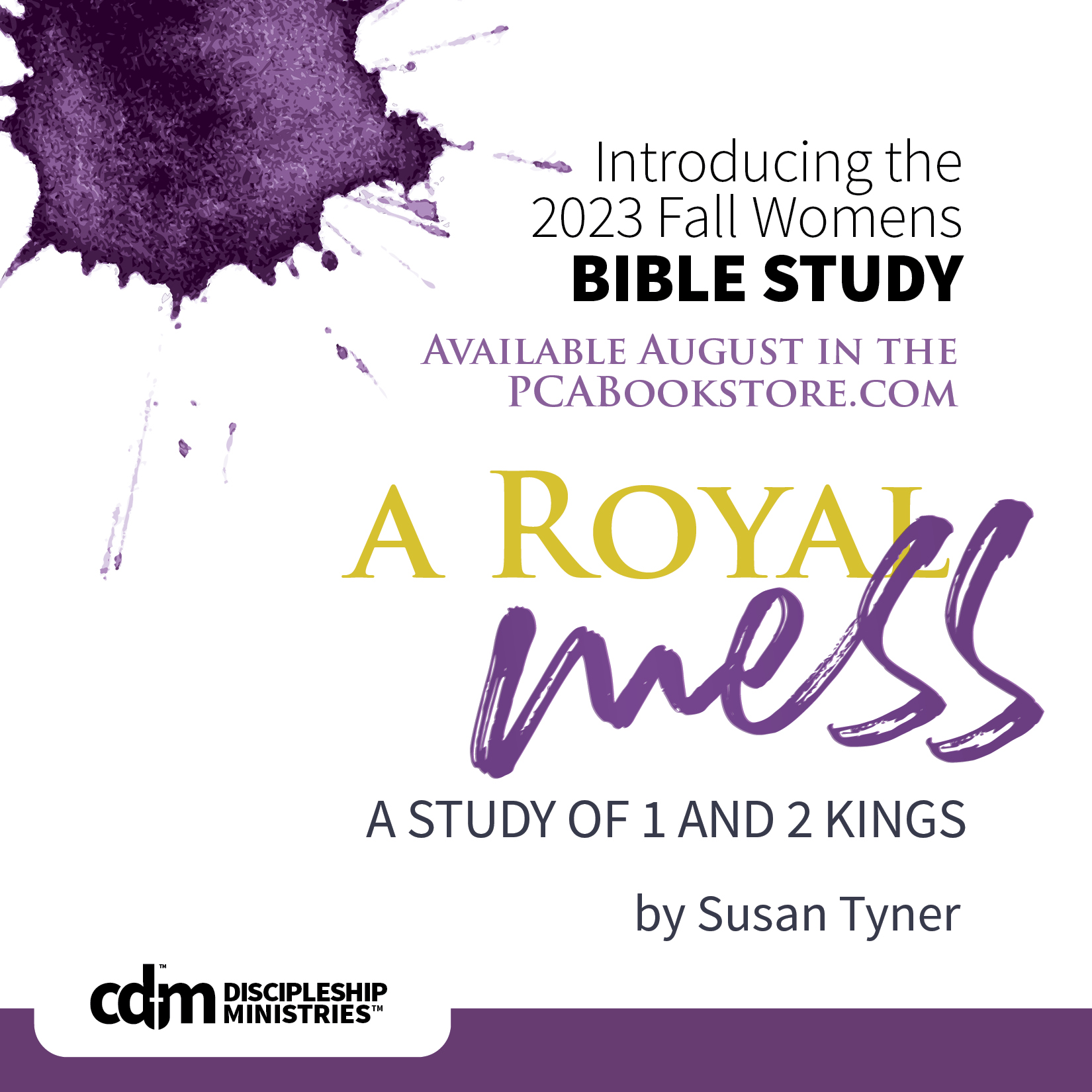
SUSAN TYNER|CONTRIBUTOR What do cannibalism, child sacrifice, and church people all have in common? To answer, open the Book of Kings. Strange to combine those three in the same sentence, yet the writer of 1 & 2 Kings shows how God’s people can sink into the worst kinds of sin. But how can a family of four sitting in the pew every Sunday possibly be in the same category as Hannibal Lector? Find out by grabbing some friends to study Kings. Between Moses’s burning bush and the Christmas angels’ song, you’ll discover stories of kings and prophets, miracles and murder, and a tragedy on display for all who care to read it. But why would such a shocking book make a good Bible study? How can Israel’s degeneration impact one’s spiritual walk today?  I offer three ways they’ve helped me in mine. You see how sin creeps in. Kings starts off so well. As King David passed his scepter to his son Solomon, Israel was poised for greatness. She thrived under Solomon’s rule. However, underneath all the gold and glitter, the crown was cracking. Nine hundred wives plus three hundred concubines can do that to a man. Did they bring a lot of credit card debt into the marriage? Maybe PMS on a grand scale? No, they brought their false gods. And, by the end of Solomon’s life, his heart had fallen out of love with the LORD and in love with their foreign gods. Lesson? Close associations can steer your heart. Choose ones who have the same soul-spirations as you do. Solomon wasn’t the only king who was disloyal to the LORD. We see this sort of creep in—marrying those outside their faith, welcoming other faith traditions, and living a life less in line with God’s law and more in line with the world—all along the way in Kings. This flirtation with sin happened back then—and now. You see where sin can take you. By the end of 2 Kings, we meet Manasseh. During his rule, Jerusalem, God’s favorite city—the place where He put His name—was overrun by foreign religions. In God’s own temple stood an Asherah pole and in His court were altars ready for astral worship. This is tantamount to a husband inviting his mistress into his wife’s bedroom to wear her lingerie, try out her perfume, and sleep in her bed. In this case, God is the one betrayed. Ezekiel 6:9 states plainly how that made their God feel, “how I have been broken over their whoring heart that has departed from me and over their eyes that go whoring after their idols.” Whoring? Can we say that word in a Bible study? We need to because we may be as guilty as Israel was then. Kings challenges us to ask, who are our Asherahs, our Molechs, and our Baals today? We may not bow down to the sun, but do we bow before people’s opinions? Do we overcommit to please family or to impress co-workers? A church leader may not offer child sacrifices but would she drive her daughter to get an abortion to cover up a teenage pregnancy, serving the god of her reputation? While an Asherah pole isn’t front and center in our living room, do we look at our bank balance or God’s word more?...

A Bible Study for Mature Audiences2023-11-15T22:01:50+00:00

Freedom From the Idol of Control

VAL PETERSON|GUEST I grew up going to a summer camp where the campers would repeat a chant at the start of every day. The Camp Director would call out, “If it’s to be…” and the entire camp would shout back, "It’s up to me!”  I confess that at the time, I didn’t think twice about what kind of mindset this was instilling in me. In the moment, it seemed like a great way to encourage kids to get along, try new things, and make the most of our days spent away from home. While it’s been decades since I attended that camp and shouted the chant, it continues to be my mode of operation. It seems that with the more kids I have, the life experiences I walk through, and the responsibilities I carry on my plate, the temptation to believe this lie only grows stronger.  When Desire for Control Shapes our Life What’s most frustrating to me is that I have experienced “that breaking point.” After walking through the near loss of my husband’s life to a brain tumor, you would think that I would know by now that all control lies in the Father’s hands. In the darkest moments of that season, there was nothing I could do but trust in the Lord. Yet here I am today, still believing and living by my childhood summer camp chant.  I relate to the apostle Paul in Romans 7 when he wrestles with himself saying, “For I do not understand my own actions. For I do not do what I want, but I do the very thing I hate” (v.15). I hate believing that it is “up to me” to make things happen in and around my life. Yet I am discipled by a culture that says “YOLO” and to “live my best life.” Whether it’s in manipulating circumstances to work in my favor, taking on a role that is not mine to fill, or just reaching for my phone in a moment of uncertainty, the temptation to believe that God is holding out on me and the resulting grasp for control often rules the functional theology of my life. This desire for security, productivity, and knowledge comes from a deeper belief in the lie that it is up to me to sustain the joy and vitality of myself and my family, which only leads me to feel less secure, more anxious, and out of control... 

Freedom From the Idol of Control2023-08-15T13:14:48+00:00

God’s Transforming Work in the Life of Our Sons

JESSICA ROAN|GUEST If there’s one subject I know a lot about, it’s teenage boys. I had only one brother, only male cousins my age, a male best friend, am raising two sons, and am surrounded by them daily in my high school classroom. Boys can be rambunctious, funny, squirmy, hot-headed, sensitive, and sometimes complicated. For some of us, parenting or mentoring teen boys feels frightening, like trying to tame a tornado you can’t even track. And yet, when I listen to the woes of other boy-moms or fellow teachers, I find myself smiling. Not because the challenges they face aren’t serious or concerning at times, but because I have seen the other side. My own father, my husband, and numerous past students were all once teen boys whom people were very concerned about. Were the concerns valid? Yes. Will I have many concerns about my own sons and future students? Absolutely. But I have seen God transform even the most challenging teen boy into hard working, loyal, sincere men, and yes, into men after his own heart. God Loves Making Immature Boys into Godly Men He was young and insignificant, so unimpressive that his father didn’t even consider him when Samuel came to call. The prophet was looking for a king, and David couldn’t possibly be it. He was too small, too young, and not strong enough for a job like that. While Samuel observed the sons of Jesse, “ . . . the Lord said to Samuel, ’Do not look on his appearance or on the height of his stature, because I have rejected him. For the Lord sees not as man sees: man looks on the outward appearance, but the Lord looks on the heart’” (1 Sam. 16:7). By God’s power, David kept Saul subdued with the sound of a lyre and defeated Goliath with a slingshot and stone....

God’s Transforming Work in the Life of Our Sons2023-08-15T13:21:29+00:00

Encouragement for the Weary Mom

KATIE POLSKI|CONTRIBUTOR Just a few days ago, I picked up my phone to facetime my oldest. I looked at my reflection in the phone as I waited for my daughter to answer and noticed how tired I looked. “Does my face always look this exhausted?”  I asked my daughter when she answered the call. “Mom,” she said, “you look like you always do.” I suppose it should be no surprise that the daily grind begins to show itself physically. Work, grad school, and other responsibilities certainly make me look forward to laying my head on the pillow each night. But where I feel the greatest weariness, at times, is in mothering. Being a mom is one of the most rewarding jobs the Lord has given me, but it has also been the most wearing. From infancy on, a mother regularly plays the role of referee, chauffeur, counselor, comforter, guider, provider, educator, prayer warrior, discipliner, and the list runs on. It’s no wonder motherhood can make us to feel worn down and inadequate. There are many days that I just don’t feel up for the job of being a mom. And thank the Lord for this. Gratitude For Our Insufficiencies Why be grateful for my inadequacy? Because if my children always obey, if I always feel like supermom, then I would have no reason to cling daily to the cross. Without coming to the end of my rope, I would stand in my supposed self-sufficiency rather than recognize the necessity of Jesus’ grace...

Encouragement for the Weary Mom2023-08-15T13:34:22+00:00
Go to Top